
Marion County Most Wanted Access
Marion County does not publish a verified sheriff's list of wanted people. There is no official list URL. There is no name-search warrant portal, no entry count, no stated update schedule, and no photo-bearing roster. No Warrant Wednesday feature exists either. No reward program or Crime Stoppers channel appears anywhere. That gap matters. Any page of names and faces floating around would not be an official Marion County record, and it invites errors about who is actually sought.
What the sheriff does publish is a Civil Process & Warrants page. It describes an office function. That function covers serving civil process along with documents like civil orders for arrest, tax warrants, criminal summonses, and warrants. The page will not confirm an active warrant or show a person's status. It does not work as a live search. Service duties are one thing; a public lineup of names is another.
For reference, the county's warrant-service page is linked below. It explains the sheriff's role. Just as clearly, it shows why no person-by-person roster or image set can be pulled from it.
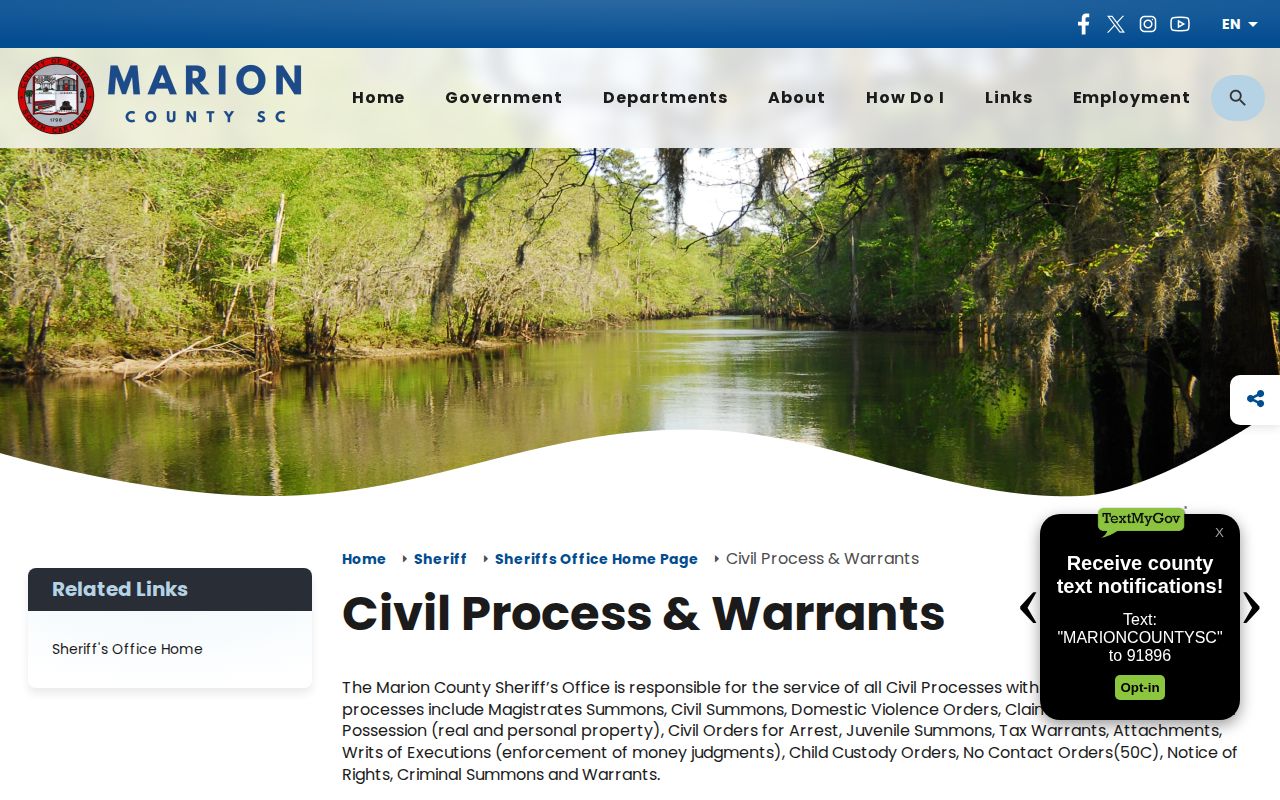
The official source is a service-information page. It is not a gallery. It is not a warrant-status database. For current direction, use the court and sheriff contacts below instead of trusting a search result, an old image, or a third-party profile.
Marion County Wanted Listing Evidence
Suppose the sheriff someday posts an official wanted list. The source would still need scrutiny before anyone repeats it. No current Marion County list exists to show which fields appear, whether photos are included, how many entries there are, or how often it refreshes. So the evidence standard below is conditional. It lays out what a future official list would have to display before a reader could fairly call it current or complete.
| Evidence to verify | Why it matters before a listing is described |
|---|---|
| Official county or sheriff URL | Confirms that the source belongs to the originating agency rather than a reposting service. |
| Dated review and entry count | Shows when the list was checked and whether a stated total actually appears. |
| Displayed fields | Separates an agency’s exact wording from details added by a secondary source. |
| Photo policy | Establishes whether the agency itself displays an image. A booking photo is not assumed from an arrest record. |
| Update evidence | Allows readers to judge whether a date, timestamp, or publication-change notice supports a current-status claim. |
| Official tip or reward contact | Prevents a private contact method or an unverified reward claim from being treated as agency instruction. |
Until those facts show up on a live official source, treat every extra detail as unknown. No photo policy, reward, anonymity promise, or listing routine can be assumed.
Marion County Warrant Check Steps
A public court case helps, but it is not real-time proof of an active warrant. Use the South Carolina Judicial Branch Public Index to find a Marion County case. Pick the right court when that choice appears. The index locates court activity. It does not replace a direct answer from the responsible court or a lawyer's advice.
- Search the Public Index with the person’s correct name and select Marion County and the appropriate court level when possible.
- For magistrate-court or lower-level criminal and traffic questions, call the Marion County Magistrates Office and ask how official process information is handled.
- For circuit or family-court record questions, contact the Clerk of Court with available case details.
- Speak with an attorney for personal legal advice and a safe resolution path. A written county request may be appropriate for a record, but active law-enforcement material can be exempt or redacted.
Booking and custody channels are separate from a warrant check. The Marion County booking-record and roster path can help separate a current detention record from a later release or court case. Keep the two questions apart. A roster hit does not establish a warrant. A roster miss does not clear one.
Note: Court staff can explain records and process, but they cannot give personal legal advice or confirm a safe course of action for your situation.
Marion County Warrant Types
Warrant labels sound alike. Yet they point to different legal processes. The table sticks to general definitions. It does not claim Marion County keeps a public list for any type, and it should never be used to label a person's record without an official court or law-enforcement answer.
| Term | General meaning | Safer local route |
|---|---|---|
| Arrest warrant | A court-authorized order that permits an arrest under the process required by law. | Use the correct court contact, counsel, and official sheriff direction. |
| Bench warrant | An order issued by a judge, often connected to a missed court obligation or noncompliance with a court directive. | Check the case through the court that handled the matter. |
| Criminal summons | A formal notice directing a person to answer a criminal matter without describing it as a custody listing. | Review the court paperwork and ask the appropriate court about process. |
| Civil order for arrest | A civil-process term the sheriff lists among documents it may serve; its meaning depends on the court order. | Contact the court named in the paperwork or an attorney. |
Don't let a generic web result pick the label. The sheriff's service page and a court docket can use the same legal terms in different contexts, and a docket shifts as a case moves along.
Marion County Court Split and Alerts
Marion County splits court questions by level. The Magistrates Office takes criminal and traffic matters at the Law Enforcement Complex in Mullins. The Clerk of Court keeps circuit and family-court records in Marion. It also steers public case research through the statewide index. Route the question to the right office. That beats any broad internet search.
The clerk's published hours are Monday through Friday, 8:30 a.m. to 5:00 p.m. Magistrate court covers lower-level criminal and traffic matters within its jurisdiction. The clerk's circuit-court records serve a different slice of the case system. A missing online result can come from spelling, a case-number problem, the wrong court level, access limits, or a sealed record. Treat it as a dead end, not an answer about whether process exists.
Marion County Magistrates Office
2715 E. Highway 76, Suite B
Mullins, SC 29574
(843) 292-5238
Marion County Clerk of Court
1305 N. Main St.
Marion, SC 29571
(843) 423-8240
The detention center points to SC VINE as a documented custody-status and notification route. VINE covers participating adult custody status. It is not a warrant database, not a court outcome, and not a stand-in for the local court contacts. No dedicated Marion County sheriff app turned up in the official local sweep. The detention center named Mobile Patrol as a data-feed destination, not as the sheriff's own app.
Marion County Safety and Tips
Marion County has no verified Crime Stoppers program, reward offer, or online tip form. Don't count on anonymity promises either. If you have information about a fugitive, the sheriff office's regular contact line is the right place to start. Share only what you know. Then let them take it from there.
Marion County Sheriff’s Office
1811 N. Highway 501 Bypass
Marion, SC 29571
(843) 423-8216, option 2
A warrant can be reduced, dropped, or resolved through a plea before the case ever reaches trial. Outcomes live in the court record. Check there before drawing conclusions about where a case stands, and revisit it if the public record changes later.
Note: A name match alone can be wrong, especially when records lack a birth date, case number, or the correct court level.